Welcome to the new-look crammedwithheaven.org blog and website. If you have been here before, or if you are a follower and have wondered about the site’s inactivity, then I am happy to announce a new beginning.
Not only do we have a new and clearer appearance to the site, but the content has been revised and refocused. Most importantly, in its new era there will be regular blogs and an expanding fund of resources on some of the pages.
When I began the blog in 2011 I was on study leave in Italy and was reflecting on art and spirituality. You can still find my musings my Italian Journey page. Since then I have done a lot more painting and, I hope, a lot more praying. You can find some of my more recent art works through the GALLERY menu and there will still be a focus on the visual arts in this site. But I now want to both widen the range and sharpen the focus of crammedwithheaven.org.
The range of my musings will continue to embrace art and spirituality but will now also include poetry. In the spirit of a reflective practitioner, I want to both practise these things and reflect upon them. The static web pages will offer resources for worship, together with some of my paintings, poems and prayers. There will also be a small number of pages dedicated to the academic study of these creative areas and their relationship to praying and doing theology. The now-to-be-regular blogs will offer a mix of reflection, study and artistic creations of one kind or another. So:
PRAYER, PAINTING AND POETRY
– REFLECTIONS, STUDIES AND RESOURCES
I hope you find this new era of crammedwithheaven.org both interesting and useful. If you do then please tell a friend!
I had ordered it long before publication so I opened the book with relish and anticipation when it finally arrived. The old adage tells us that ‘Those who can’t, teach!’ I want to offer a variation: ‘Those who can’t, buy lot’s of how-to books instead’ and so spend their time reading about the activity rather than doing it and learning from their mistakes. Shelves full of books on how to pray compete with shelves of books on how to paint and draw!
Anyway, the book in question was Painting Light in Oils by Peter Wileman and Malcolm Allsop (Batsford 2011). Peter Wileman is currently president of the Royal Institute of Oil Painters and the book is stuffed full of his impressionistic, mainly landscape and people, paintings. He is a fine painter and has a lovely knack of using a narrow range of tones and colours to frame an area of bright light which sings (or zings) as a result.
In answer to the question ‘What shall I paint?’ he offers this observation:
Novice artists often feel that for a subject they must find something that is beautiful or dramatic in itself. The problem for many people is that they’re more experienced in taking a photograph than choosing a subject for painting. A photograph tends to be the classic ‘view’, whereas an interesting painting usually shows a much less obvious take on a location.
In fact, your subject may be completely mundane; it may just be a collection of interesting shapes, a certain light effect, or a pattern of colour and tones that has made you want to create a painting.
I write on the last day of my sabbatical study leave and I have been reviewing the last three months – both the long trip to Italy and the drawing, painting and reading I did both there and on my return. As I leaf through my sketch books, I seem to feel more satisfaction with the pen and ink studies than with the pen and watercolour paintings. This may of course have something to do with my relative (in)competence in each media. However, I think it’s more likely to do with subject matter.
The watercolours have tended to be less experimental and more concerned with grand views of well-known landmarks – like some of my photographs. The ink drawings tend to be on a smaller scale and capture some aspect of a street or building which has interested me. Pen, sketchpad and water-brush are, after all, more portable than the full watercolour kit and a drawing may only take ten or twenty minutes. As a result, the drawing is more responsive and less predictable. What oil painting I’ve managed since my return has also tended to be the grand view – and grand view in the middle of the day when I took the reference photographs rather than a well-known scene transformed by dramatic morning light or stormy weather.
Two things follow for me. First, a practical agenda. I must continue to paint from my travel sketches and photographs, but must look for those views which reflect my personal impressions and experiences rather than grand views – more chamber music than grand opera! I achieved this in some of my photographs, now I need to move to a stage of synthesis in my painting.
The second thing is more a line of reflection. Wileman’s comment, about the mundane and less obvious ‘take’, chimes with other thoughts and readings. Frederick Franck, in his The Zen of Seeing: Seeing/Drawing as Meditation (Wildwood House 1973) presents drawing as a way of seeing which apprehends the reality of what is before us. He suggests that drawing is
a way of focusing attention until it turns into contemplation, and from there to the inexpressible fullness, where the split between the seer and what is seen is obliterated. Eye, heart, hand become one with what is seen and drawn, things are seen as they are – in their ‘isness’.
This was a road travelled by Thomas Merton who in the photography of his later years gave attention to very ordinary things but in a way which showed their extraordinary wonder. John Lane, in his The Spirit of Silence: Making Space for Creativity (Green Books 2006), writes,
The beginning of seeing lies with the rapt attention of unpretentious, everyday things; things ignored, mundane, unexceptional, commonplace; things lying about in rooms, things like the wrinkled sheets of an unmade bed, the refracted stems of a bunch of tulips in a glass pot, the rust on a sheet of corrugated iron, the pattern of porridge left at the bottom of an unwashed pan.
Giving attention is akin to prayer. It is relating to the world in such a way that the ‘I’ doesn’t get in the way of the ‘eye’. It is an openness to God’s world in its infinite richness and variety – not just the big picture, but the intricate detail – what we might call ‘the calligraphy of God’.
It was a mealtime conversation in Rome while I was staying at the Venerable English College, the Venerabile. I was sat opposite a young priest from Malta who had come to Rome for further theological studies and was particularly interested in art history. He had just written an essay on art and the liturgy, and – well – the conversation flowed from there.
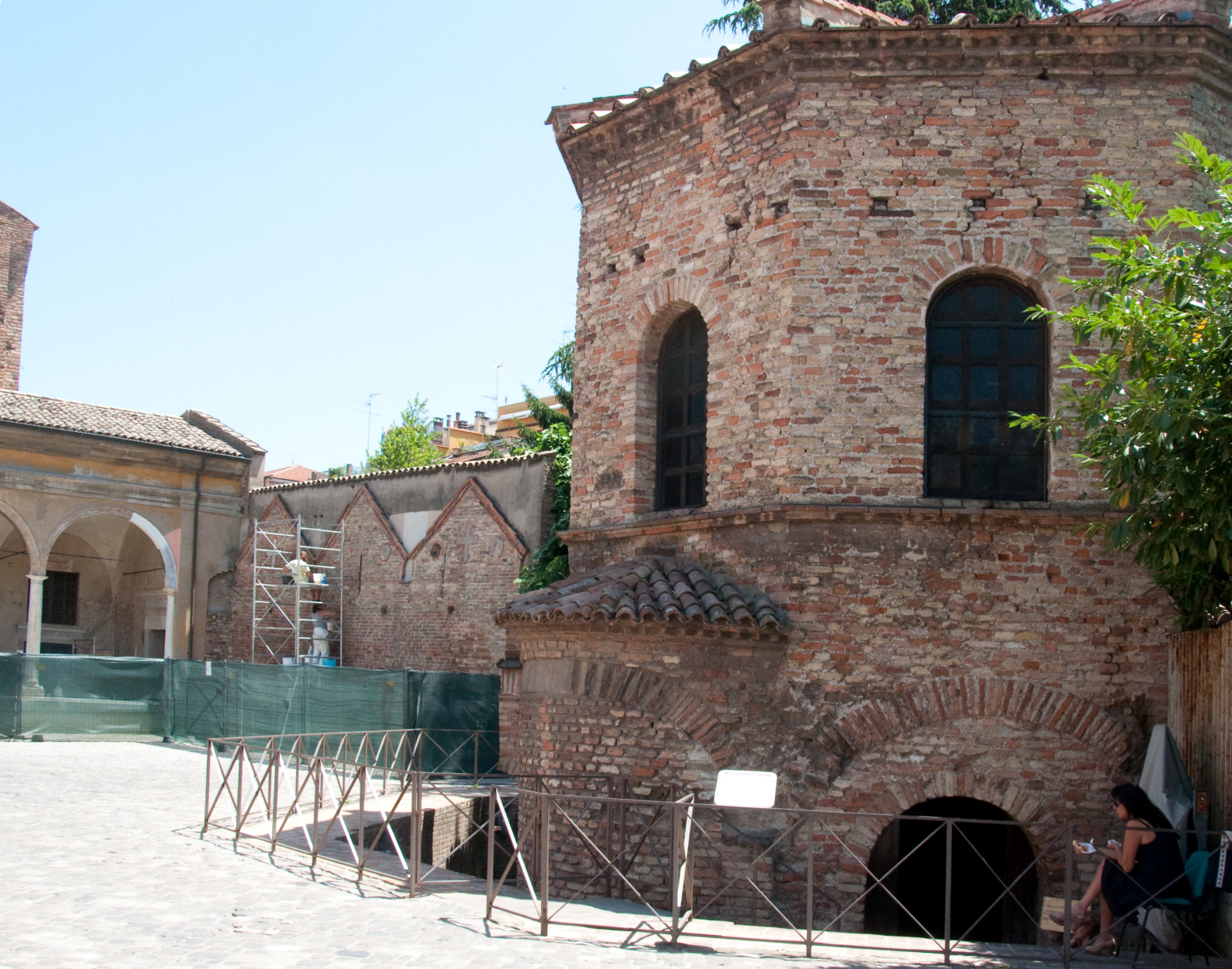
Somehow we got on to the subject of baptistries – it wasn’t me, honest! He commented on how most of the early ones were octagonal. Now we are talking about the fourth century onwards when baptism was still usually administered to adults professing their faith. Often the baptismal tank would be housed in a separate building in the grounds of the church and this building, as well as the tank, is referred to as a ‘baptistry’.
Octagonal Baptistry, Ravenna
Anyway, back to shape. Often these buildings were square or octagonal with a circular dome above. It was a throw-away line from the young priest, muttered with something of the certainty of the young (or maybe the confidence of being a student of the Gregorian University in Rome): ‘Of course, these baptistries were eight-sided to symbolize the ‘eighth day’.’
Now another historical note: the ‘eighth day’ was a concept developed by early Christian writers and it means Sunday. The term focused the meaning of the move for worship on the seventh day to worship on the eighth day. Now I know that a fair number of us have sometimes wished there were eight days in a week, but I know and the early church knew that there are in fact only seven. It’s a kind of paradox or nonsense phrase.
Sunday is the Lord’s Day – the first day of the week – the day of resurrection. But the point is this – it is not just another day like the rest. Nor is it even just the first day of creation – it is the day of new creation when everything in heaven and on earth is changed because God has raised Christ from the dead. God’s future end, his eschaton, has broken into human and cosmic history and all the boundaries have been changed and expectations have been turned upside down.
The young priest didn’t need to make the connection for me. The symbolism was so rich. ‘When anyone is united to Christ there is a new world’ – ‘We have been buried with him by baptism into death, so that, as Christ was raised from the dead by the glory of the Father, so we too might walk in newness of life.’ In baptism we celebrate the life-giving, life-changing work of God who raised Jesus to life on the eighth day – the first day of a new world. And those just baptized clamber out of the water to walk in a new world, a world of the eighth day, living in the light of the resurrection.
All this is rich symbolism, great theology and inspiring sentiments. But… I wondered whether baptisteries were octagonal in order to express the eighth day – or because it was a nice shape which the architect thought would look good – or because an octagon is what you get when you put a dome on top of a square and do something artistic with the interior walls! Was it simply geometry or intentional symbolism? Or did the symbolism suggest itself once baptisteries had eight sides and someone made an imaginative leap?
This conversation was a month ago but it was brought to mind by another geometry-symbolism bit of mulling this week. Between Venice and Assisi I took a two-day detour via Ravenna, courtesy of the slow train from Bologna to Rimini. Ravenna was, for a time, the capital of the western part of the Roman empire, when it was being overrun by Goths and others. For a period it was rescued by the eastern part of the empire, based in Constantinople and in the fifth and sixth centuries a number of churches and, yes, baptisteries were built. The town boasts eight, UNESCO World Heritage sites – and on Tuesday I visited six, all within a mile of one another – and each with the most incredible mosaics.
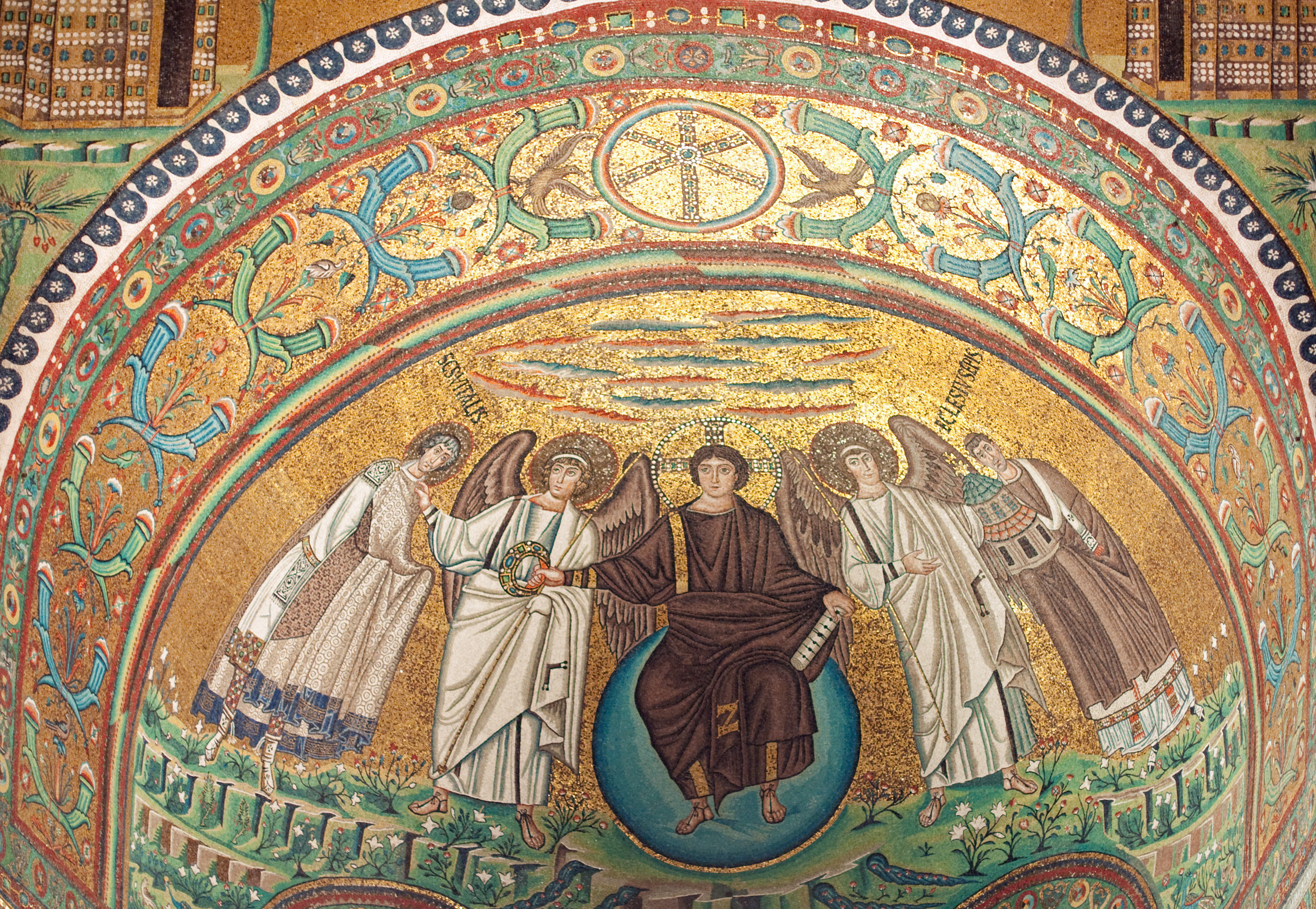
Christ in Glory, St Vitale, Ravenna
St Vitale is one of the largest buildings and – yes – it’s octagonal. Here is a photo I took of the image of Christ in glory which faces the congregation from above the altar. It is incredible that it was made in 548 – nearly fifteen hundred years ago. The mosaics in Ravenna are stunning and are claimed to be ‘the best Byzantine mosaics outside Constantinople’ (Istanbul).
The Cosmic Cross, Ravenna
Back to my theme. In two of the church buildings I found domes decorated as starry heavens – blue background with gold stars and a central gold cross. I sat in one chapel and gazed at this beautiful image. As I looked I realized that all the stars were eight-pointed! Now I think I was brought up in the belief that stars had five points – if you know what I mean. Then I thought, well, that’s just four lines imposed on one another – how I would normally draw an asterisk – geometry again.
And then the geometry or the symbolism didn’t matter. For I was seeing not simply the stars but the cross. Here was the cosmic cross – the redemption of all things through Christ. Here was a claim about what kind of universe we inhabit – fallen, broken, but redeemed. Whether through geometry or intentional symbolism, here was an eighth-day realization that everything was different because of the cross and resurrection of Christ – all creation was to be seen in the light of the cross.
It is fitting that the heavens should rejoice:
and that the earth should be glad,
and that the whole world, both visible and invisible,
should keep the feast.
For Christ is risen, the everlasting joy.
Now all things are filled with light,
heaven, and earth, and all places under the earth.
All creation celebrates the resurrection of Christ.




 Chris Ellis Art