Mary Overload?

Hands up those who can remember Michel Quoist’s Prayers of Life! As a teenager they had a profound impact on my sense of where God is to be found in the gritty realities of everyday life. From an ecumenical perspective, the prayer ‘Help me to say Yes’ broadened by Protestant understanding of Mary, with its line, ‘God needs my Yes as he needed Mary’s Yes’.

Protestants have often, or even usually, ignored the biblical figure of Mary in reaction to what they see as the excessive claims of medieval and Catholic piety and dogma. They have even muttered such things as ‘Mariolatry’ (often while practising their own ‘bibliolatry’ – but that’s a debate for another day). In contrast, and prompted by Quoist, I have, each year during Advent, preached about Mary as a model of faith, an example to us on how to respond to God’s call – ‘Here I am, the servant of the Lord; let it be according to your word.’ I have even meditated upon the charismatic implications of the work of the Holy Spirit conceiving Christ within her.

Yet this week I found myself reaching a kind of Mary overload. Two things came together. First, while on my Italian journey I have been reading each day a few pages of Thomas Merton’s Seeds of Contemplation. It is, I believe, a spiritual classic but even classics are of their time and this isearly Merton and, at times very pre-Vatican II (because, of course, it was). Published in 1949, it is the fruit of the early years of his contemplative monastic journey when he seems to have been ecumenically unaware.Despite this, the book is full of gems – or perhaps I should say ‘seeds’ that encourage the reader to contemplate. But of course it is human, and so mixed.One moment he writes,

… if you want to have in your heart the affections and dispositions that were those of Christ on earth consult not your own imagination but faith. Enter into the darkness of interior renunciation, strip your soul of images and let Christ form himself in you by His cross. (p96)

Then within a few pages he is talking of Mary’s soul as ‘absolutely full of the most perfect created sanctity’ (p101), and ‘We believe that hers was the most perfect sanctity outside the sanctity of God…’ (p100)  I could quote further, but I expect you get the gist. I started muttering about the Vulgate’s mistranslation ‘full of grace’, about scriptural warrants for such ideas – and then tried to be eirenic and generous.

Coronation of the Virgin by Michele Giambono

The second thing was just the next day. I entered the first room of the Academia art gallery in Venice, with its medieval and early renaissance religious art, and found that nearly all the pieces were of Mary. Now, I’m very happy to spend time in front of pictures of the annunciation (Mary’s Yes) or images of the Virgin and Child (symbolic of incarnation) but when I realized that a third of the works in the room are representations of the coronation of the Virgin Mary in heaven – well – I had to take the weight off my feet and take stock. The first reaction was emotional and negative – then the reflection began and I tried to enter the world view of these artists and the spirituality that they express and provoke.

Leave aside for the moment the theological qualifications and caveats – I worked my way through them apace. Yes, coronation speaks of hierarchy. Yes, Mary seems to be given a mediatorial role which should only belong to Christ. Yes, there are dogmatic formulations about perpetual virginity and ‘the assumption of BVM’ which Protestants find very problematic…. yes, yes.

Then the closing lines of Charles Wesley’s Love Divine came to mind:

Changed from glory into glory,
Till in heaven we take our place,
Till we cast our crowns before Thee,
Lost in wonder, love, and praise.

Here is a vision of the consummation of all things in which we all have crowns! Is it too big a step to see in the medieval vision of Mary’s coronation a prefiguring of our own destinies where ‘Love [bids] us welcome’ and gives each of us the place of honour. If this interpretation has any merit then the coronation becomes a symbolic representation of Mary’s place as the first Christian – chronologically – and, perhaps, prophetically.

Her Yes makes room for the Holy Spirit to indwell and enable Christ to be born. She is, as eastern Christians say, the Theotokos, the bearer of God. She also stands at the cross while most of the disciples ran away… And, perhaps, in these pictorial representations of her welcome in heaven we see the welcome that awaits all who trust in the child she bore for us and our salvation.

So – back to Merton. No coronation here, he is talking of Mary’s poverty and lowliness as expressed in the Magnificat.

It is because she is, of all the saints, the most perfectly poor and the most perfectly hidden, the one who has absolutely nothing whatever that she attempts to possess as her own, that she can most fully communicate to the rest of us the grace of the infinitely selfless God.

Well, I – we – might still hesitate with some of that, but its central theme is rich. As Paul puts it, ‘God’s weakness is stronger than human strength’; or as Kendrick puts it, ‘Our weaknesses become his possibilities’; or, as Merton continues:

This absolute emptiness, this poverty, this obscurity holds within it the secret of all joy because it is full of God.

Facing God in Church

After a week’s holiday the blogging continues – as does my Italian Journey page.

The guide book tells me that there are over a hundred churches in Venice – we are talking buildings, of course, for some of them are ‘redundant’ and some are now concert venues for the ‘Venice Experience’ of Vivaldi’s Four Seasons in period costume. Two church visits have set me thinking.

Approaching San Marco

Yesterday was Pentecost Sunday and I walked to San Marco to worship at solemn (sung) mass in the basilica. I had visited last week as a tourist (in the rain) but now I wanted to return as a worshipper, albeit one who would have to participate in a language where I can manage (badly) a couple of dozen words and then dive for the phrase book.

At first, the body language of the building was an ambivalent presence. I arrived early and had time to look around from my seat before the service began. I thought of the wealth of Venice as a trading city, of plunder from Byzantium and untold inequalities that enabled some to donate so much wealth for civic splendour and personal glory … and perhaps for the glory of God (very similar thoughts that come to me whenever I enter Westminster Abbey).

The shape of the liturgy was familiar so I was able to follow the service of the word and then the familiar movements of the Eucharist. I had a fair idea what the readings were likely to be and so reflected on Acts 2 and John 20. The sung bits were in Latin so I knew them from concerts I have sung over the years and was able to join in – though not vocally  – the choir was beautiful, singing renaissance settings from a gallery high up above the sanctuary (in one of the galleries for which Monteverdi wrote his Vespers of 1610).  The archbishop was kindly and there was a confirmation of some young adults to boot. The sharing of the peace was warm and a good time was had by all.

But what struck me were the mosaics – especially in the domes and the half dome of the apse above the high altar. From my place I could see throughout the service three images of Christ. First there was the crucifix above the screen between chancel and the nave – above and behind the presiding archbishop. Then there was the image of the ascended Christ above the congregation in the Ascension Dome over the crossing. But most striking was the Christ Pantocrator – Christ, Ruler and Sustainer of all – which faces the congregation from the apse above the high altar. It was the continual presiding of the risen Christ – over the cross of crucifixion, over the reading and preaching of the word, over the praise, over the offering and breaking and sharing of bread – Christ over all, in all through all, for all. I didn’t understand many words – but I knew the gist of the service, and I know and am known by the one who holds all things in being and whose name is Love.

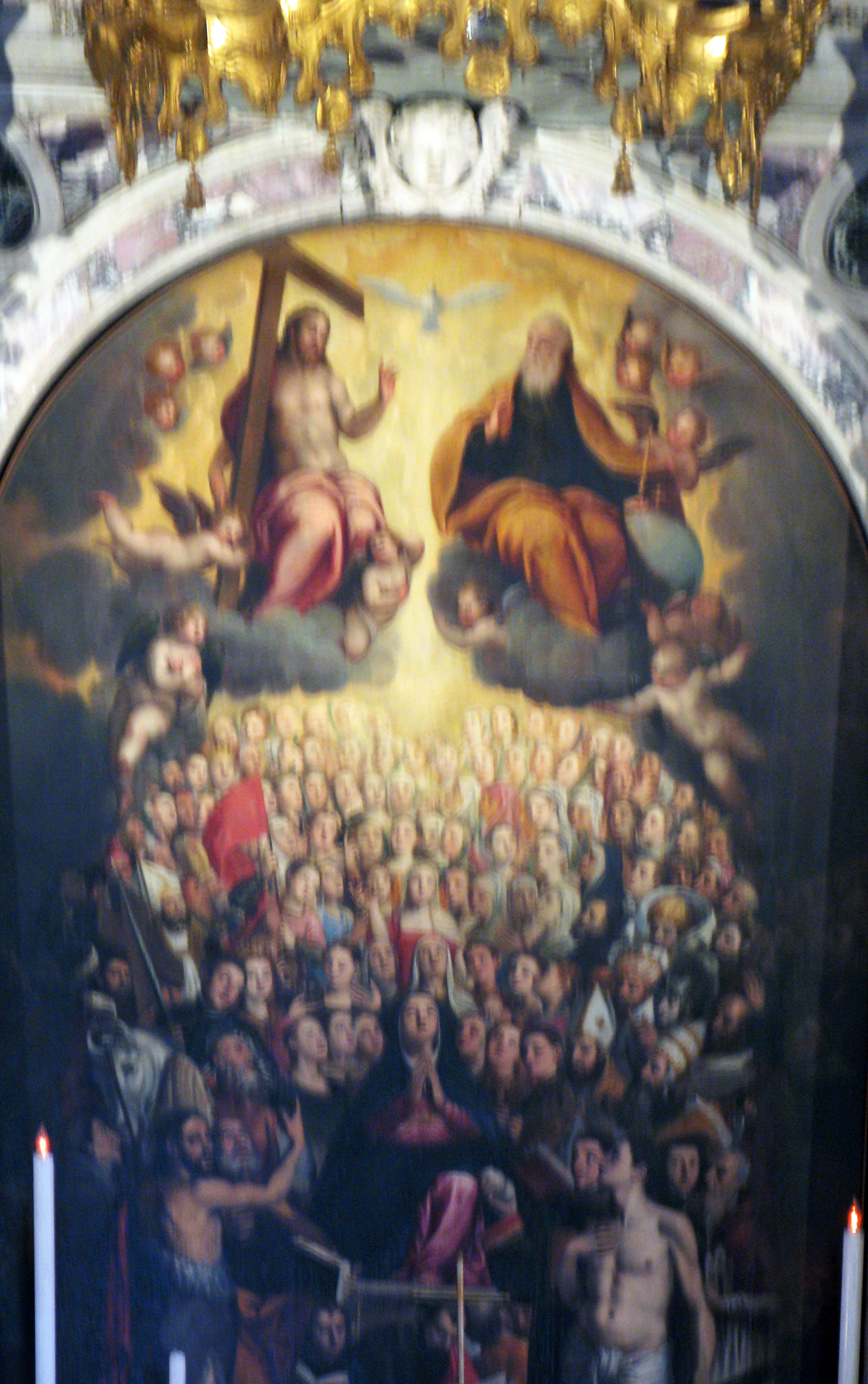
What a contrast was the second church. This morning, I was on my way to the supermarket – a circuitous way as all journeys seem to be in Venice. On foot, over stepped bridges, down alleys and around corners. And with the canal equivalent of a back lane on my left, I noticed a small church on my right. Exploring inside revealed a building down at heel architecturally but vibrant with signs of current use and much popular devotion. A head just showed above an open copy of L’Oservatore Romano, the Vatican newspaper. On my tentative ‘Scusi’ a kindly face appeared above a Franciscan habit and he readily agreed that I could photograph a painting above the main altar that had attracted my attention. Originally a Carmelite convent church, it is now called Ognissanti  – All Saints – and they are very much in evidence in the sixteenth century altar painting which portrays a crowd of saints adoring the Triune God. Perhaps not a great painting, and certainly a very dimly lit architectural setting, but the portrayal of the Trinity is theologically and spiritually powerful.

God from God, Light from Light, True God from True God...

Here is no suggestion of hierarchy, so common in much western art. Rather, here the Son, holding the cross as a sign of his incarnation and sacrificial death, is on an equal level with the Father and the Spirit hovers between them, the bond of love. Dingy and dark, surrounded by peeling walls – but the body language of this little church speaks of lived faith and faithful prayer and, at its heart, the love of the Triune God. So I took my photograph, then sat reflectively, then  knelt prayerfully. Finally, with a ‘Grazie’ to the friar, I went to the supermarket.

Looking up

Annigoni St Joseph and the Christ Child

Yesterday I visited four churches and a library – all on foot in the centre of Florence. Each contained great works of art by any measure of the word. The Medici Chapels contain those iconic tomb statures of Michelangelo – although he never finished the series, what we have are stunning.

The San Lorenzo church next door boasts two – yes two – pulpits by Donatello. It made me wonder whether there were any dialogical sermons in the fifteenth century. I don’t think so… However, any preacher would need a good head for heights as the only way up seems to have been my means of a ladder.

I particularly wanted to visit Santa Maria Novella to see one of the those paintings which were a turning pint of their era – in this case Masaccio’s portrayal of the Trinity. Here it was not so much spiritual death which attracted my attention  as a sense of standing – yes – at a turning point.
There are two remarkable features of this painting – and we have to remember that it was painted about 1428. First is the striking use of linear perspective – that ‘trick’ of drawing lines in such a way as a two-dimensional surface has the appearance of being three-dimensional. Apart from the technical stuff to help the artist, this procedure actually means painting what you see rather than what is there. So we ‘see’ railway tracks converging – so when we draw them like that they appear far more realistic than if we draw two parallel lines on the page.
You paint what you see – not what you know – now there’s a thought for a future reflection! This approach to perspective was a discovery of the early Renaissance and although Masaccio was far from the first to use it, his Trinity is a stunning early example.
But this fresco is also significant because of the realism of the figures and especially the faces. This is a long way from Giotto, father of Renaissance painting, beautiful as his paintings are. Here is a different kind of perspective ‘trick’ from manipulating of lines. Now the shading of forms, where light models shape, gives them a three-dimensional body on a two-dimensional surface. This technical developement, coupled with Masaccio’s humanity, results in human faces full of emotion and character. I have to admit that God the Father seems to be rather lacking in emotion – but that probably reflects the theology of the time! An exploration of scripture leads us to many places where images of emotion – anger, compassion etc – are attributed to God. But whatever the theology of God, we can recognize living, feeling, responding human beings in this fifteenth century masterpiece.
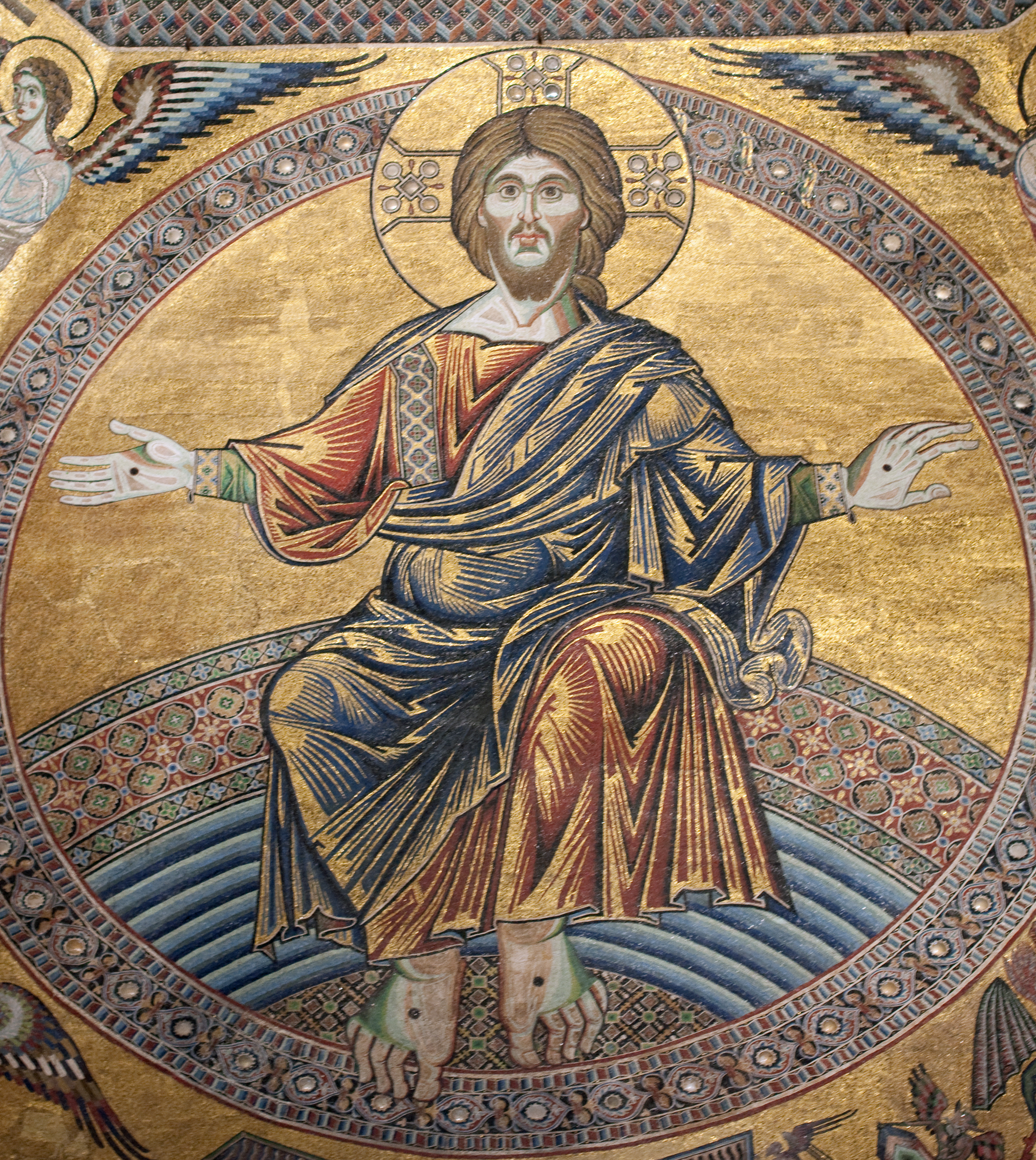
I’ll leave the visit to the library for another day. These two images of Annigoni and Masaccio are taken off the web as neither church would allow photography, even without flash. However, when I passed the baptistery next to the Duomo and found that there wasn’t a queue, I seized the opportunity and went in to see the medieval mosaics which cover the domed ceiling (I couldn’t find a font let alone a baptistery – but that’s another story). The dome is covered with scenes portraying the Last Judgement – and some of pretty scary. But the eye is inevitably drawn to Christ enthroned on the judgement seat. It wasn’t easy to see some of the detail from the ground as the mosaic of Christ must be 40-50 feet up, but when I had taken my photographs and inspected them on the laptop I saw very clearly the scars of the nails on his hands and feet. The one who judges is the one who has laid down his life for the redemption of the world. Whatever our views or expectations of the judgement are we must hold on to this central affirmation and hope – the judge is the one who has washed disciple’s feet, lifted fallen sinners out of the dust and died for our salvation.  Images and phrases tumble after one another – Here is love vast as the ocean – the lamb that was slain sits on the throne – but especially: Kyrie eleison, Christe eleison, Kyrie eleison – Lord have mercy.
Christ enthroned in judgement - the Florence baptistery